

Attractions in Ronda: Must-See Sights for an Unforgettable Visit August 21, 2024 – Posted in: Spain, Travel – Tags: Andalusia, Archaeology, Attractions, Hiking, History, Holiday, Ronda, Spain, Vacation
*The article contains advertising links, read more here: Affiliate Partners*
Discover Ronda – 10 Must-See Attractions!
Most tourists come to Ronda to see the beautiful bridge, Puente Nuevo. The bridge divides Ronda into two: to the north is the new district with its wide shopping street and many exciting restaurants. To the south of the bridge, you’ll find the old Moorish quarter with its narrow streets and charming whitewashed houses. It is here in La Ciudad, as this district is also known, that you will find most of Ronda’s attractions.
In this article, we’ve written about some of the sights in Ronda that you must see during your visit to the city. However, there are many other exciting experiences in and around the city that we didn’t get to, such as the Roman city of Acinipo. If you want to explore Ronda on your own, there’s plenty of help available in Ronda’s official tourist guide.
10 Sights in Ronda You Must See
We had three nights in Ronda, so this guide gives a good overview of what you can see in a couple of days. You might not make it to all the attractions on the list, but Puente Nuevo, the water mine at Casa del Rey Moro, and the view from the Alameda del Tajo park are all must-sees.
When getting around Ronda, it’s quickest to lace up your walking shoes and explore on foot. Ronda is a small town, but with very steep streets and many stairs. So, leave the flip-flops at home and bring a hiking stick if you like. Now, let’s get out and see some sights!
1. Puente Nuevo
We arrived in Ronda on a Sunday afternoon along with the large tour buses dropping off day-trippers right at Puente Nuevo. This made it a bit challenging to appreciate just how beautiful the bridge is. As the sun began to set, the last of the day-trippers disappeared, peace settled in, and we enjoyed the magnificent bridge to the sound of birds chirping in the last golden rays of the sun.
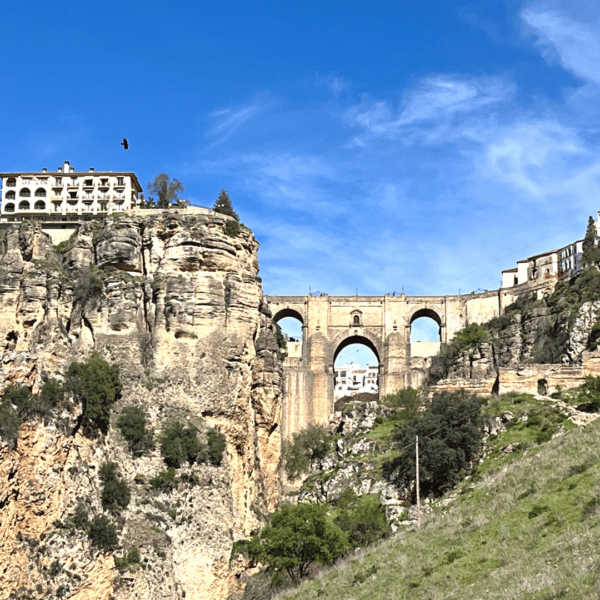
And this is how the magnificent bridge spanning the El Tajo gorge, connecting the new and old parts of Ronda, should be experienced. The bridge was completed in 1793 after 40 years of construction. When you stand in the middle, there’s about 100 meters straight down into the gorge. Beneath the bridge is a chamber that was once used as a prison and now houses the bridge museum.
Most people only take a picture of it from the path running around Parador de Ronda, the lovely hotel where we stayed. Others walk down to the viewpoint located beneath Plaza de María Auxiliadora. If you want to get to the best photo spot of the bridge, it requires a bit more hiking. We’ve written about where you can take the photo of the bridge you see at the top here: Hiking in Ronda: Discover Stunning Trails and Scenic Views
2. Casa del Rey Moro
The next morning, we got up early and set out to explore the lower parts of the city. If you walk across Puente Nuevo towards the south and the old town, you can shortly turn down Calle Cuesta de Santo Domingo.
The road leads you right past Casa del Rey Moro, The Moorish King’s House. Unfortunately, the palace was closed for renovations when we visited, but you can always stroll through the beautiful garden and enjoy the viewpoints and peacocks.
Neither the palace nor the peacocks is the reason Casa del Rey Moro is a must-see in Ronda. The ticket also provides access to the water mine, which was part of the Moorish defense system. The water mine was constructed by the Arab king Abomelic I in the 13th century. At this time, Ronda was an independent Islamic kingdom right in the crossfire between the Christian north and the Islamic Nasrid kingdom of Granada.
To survive a siege, it was crucial to have access to fresh water. Through a clever system, including a water wheel operated by Christian slaves, water was brought up to the palace and the city. It is thus an irony of fate that the water mine became the weakest point in the defense system. It was precisely here in 1485 that Christian troops managed to break in and drive out the Moors.
3. Puente Viejo and Puente de San Miguel
From Casa del Rey Moro, you can continue down towards the two lower bridges visible from Puente Nuevo. You reach Puente Viejo and Puente de San Miguel by following the road around and down until you reach the stairs and the old gate.
Puente Viejo dates back to the 17th century and is 120 meters long. The lower bridge, Puente de San Miguel, is also called the Roman Bridge and Puente Arabe. From the two bridges, you can continue into the landscape on one of the many hiking trails or down to the Moorish baths.
4. Baños Árabes – The Moorish Baths
Baños Árabes were built in the late 13th century, also by King Abomelic I. We have seen several Moorish baths around, but few are as well-preserved as these in Ronda. The baths are located in the San Miguel neighborhood, which was the old Moorish quarter.
Here, the Moorish rulers could meet to bathe and conduct business. The water came from the nearby Arroyo de las Culebras (Snake Stream), where a water wheel directed the water into the baths.
Baños Árabes are built according to Roman specifications with cold and hot baths. The Moors added an Arab-style bathhouse with horseshoe arches and the most beautiful star-shaped light entries.
5. La Ciudad
From the Moorish baths, we now head back up into the old town, La Ciudad. On Plaza de la Duquesa de Parcent, it’s time for a little break in the shade at one of the charming bars.
If you prefer to take the cake home, the nuns at Convento Santa Isabel de los Ángeles sell beautiful cakes made according to old traditions. They are open from 9:30 AM and for a couple of hours, and again from 1:30 PM to 5:30 PM.
From the square, you can also see the city’s current town hall and the church of Santa María la Mayor. The church was previously a mosque, from which four Moorish domes and a mihrab, an Islamic prayer niche, have been preserved.
To the west is the old Moorish palace Palacio de Mondragón. The palace was later rebuilt in Renaissance style and now houses the archaeological museum of Ronda.
6. Puerta de Almocábar
Walking south from Plaza Duquesa de Parcent, you reach the city’s old city gate, Puerta de Almocábar. The gate is named after the Arabic term for cemetery, which was located just outside the city wall. The city gate and the accompanying city wall were built in the 13th century, with later additions in the 14th and 17th centuries.
Few tourists venture this far, but strolling along the city wall provides stunning views of the surrounding landscape and the labyrinthine streets that remain as the Moors originally designed them.
7. Miradors
There is so much to see in Ronda. The beauty of the El Tajo gorge and the surrounding mountains will take your breath away more than once.
The best places to view the landscape around Ronda are from Plaza de María Auxiliadora and from the Alameda del Tajo park. Plaza de María Auxiliadora is located in the old town a few minutes’ walk northwest of Plaza de la Duquesa de Parcent. Many tourists naturally pass through the small park, as it is here that the path down to the viewpoint of Puente Nuevo begins. As mentioned earlier, we have written more about the path here: Hiking in Ronda.
From the Alameda del Tajo park, you can experience the most stunning sunset over the mountains. The viewpoint trail starts just north of Puente Nuevo, where you can turn down just before the Parador de Ronda hotel and walk around it. In Alameda del Tajo, tourists and locals gather in the evening to enjoy the magnificent view.
8. Plaza de Toros
Where the Alameda del Tajo park ends to the east is Plaza de Toros. The beautiful old bullring is Spain’s second oldest and is still used for bullfighting shows, though only once a year during the Feria de Pedro Romero Festival in September.
Pedro Romero is the most famous in Ronda’s legendary dynasty of bullfighters, with his grandfather Francisco Romero having founded the modern bullfighting tradition.
As you’ll notice from small plaques around town, Ernest Hemingway spent some of his holidays in Ronda. The bullring also features in his book “Death in the Afternoon” as the place in Spain where you should see your first bullfight.
9. Shopping in Ronda
It can’t all be about culture and history! Just across from Plaza de Toros is the city’s charming pedestrian street, Carrera Espinel or Calle La Bola, as it’s also known.
The pedestrian street is nearly a kilometer long, and here you’ll find plenty of ice cream parlors and small cafés. In addition to souvenirs, you’ll also find both larger chain stores and small local shops selling hats and scarves. Note that many stores close for siesta from about 2 PM to 5 PM.
10. Plaza del Socorro
As night falls, it’s time for an evening stroll. Many people gather, as mentioned, at the viewpoint in Alameda del Tajo, but the small town square Plaza del Socorro also attracts both locals and tourists for dinner or just an ice cream.
Children play around the sparkling fountains, and conversations flow in the many restaurants around the square. It’s a cozy place, and you’d have to be made of steel not to want to join in the lovely evening festivities!
More Tips for Your Holiday in Ronda
Find a Good Hotel in Ronda
Where should you stay when in Ronda? At the lovely Parador de Ronda hotel – right by the gorge and Puente Nuevo, of course! But there are other options as well, though it’s a grand experience to draw the curtains and gaze out at the sunrise over the mountain peaks. Or how about swimming in the hotel’s pool, with a view of the gorge?
-
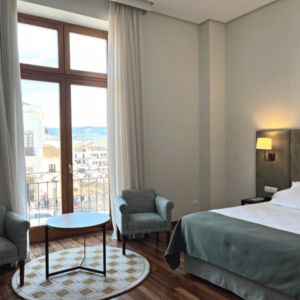
- Our hotel room at Parador de Ronda

-
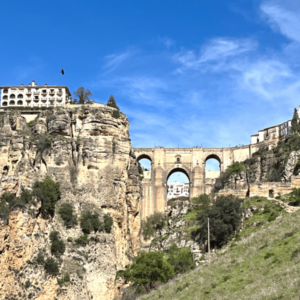
- The most photographed hotel in Spain
-
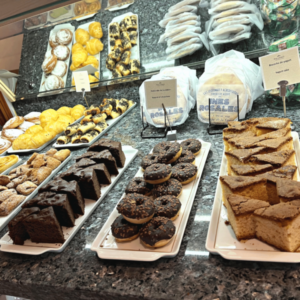
- Breakfast at Parador de Ronda
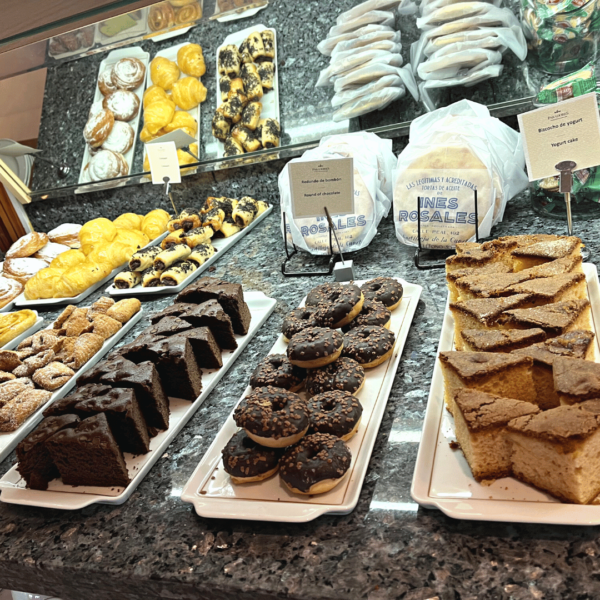
From the outside, the hotel, which by the way is the city’s former town hall, looks like a classic Spanish holiday hotel, but inside everything is new and beautiful. We stayed in a room with a view directly of Puente Nuevo. We expected a lot of noise from the bridge, but when the last bus with day-trippers leaves, the only sound is the evening birdsong over the city’s rooftops.
Breakfast deserves its own story. There’s no automatic coffee machine in the large breakfast buffet here. Instead, you get really good, strong coffee, served at your table in the most beautiful silver pot. Meanwhile, you can tell the waiter whether you prefer your eggs fried or scrambled – and he’ll bring them to you, freshly made!
Read more about the hotel here: Parador de Ronda